
You wake up already calculating how much your knees will complain on the stairs. You sit through work in Overland Park, stand up, and feel your hips lock for the first few steps. You try to be active on weekends, but your shoulder, back, or hands remind you that something still isn’t right. The most frustrating part is that you may have already tried pieces of treatment and still don’t feel like anyone has explained why the pain keeps coming back.
For many people driving in from Overland Park to our Shawnee clinic, that’s the turning point. They’re no longer looking for another temporary patch. They want a clearer answer. At LifeWorks Integrative Health, 19701 W 65th Ter, Shawnee, KS 66218, 913-441-2293, Dr. Matthew Gianforte, DC, and our multidisciplinary team look at chronic joint pain through a wider lens that includes joint mechanics, the spine, inflammation, rehabilitation, and whole-body contributors.
If you’ve been told it’s just aging, just arthritis, or just something you have to live with, there’s usually more to the story.
Tired of Living with Chronic Joint Pain in Overland Park?
Chronic joint pain changes the rhythm of your day. You move differently getting out of bed. You hesitate before carrying groceries. You skip workouts, golf rounds, long walks, or even simple family plans because you don’t trust how your body will respond.
That pattern wears on people emotionally as much as physically. Pain that lingers for months often creates a cycle of guarding, stiffness, less movement, and more frustration. You might feel fine for an hour, then pay for it later. Or you might rest for days, only to discover that too much rest made everything tighter.
It’s not just about the sore spot
One reason chronic joint pain feels so confusing is that the painful area isn’t always the true source. A knee can hurt because the hip isn’t moving well. A hip can ache because the low back is irritated. A shoulder can feel inflamed when the neck and rib cage mechanics are the problem.
That’s why symptom chasing often fails. If care focuses only on the place that hurts, you can miss the pattern that keeps reloading the problem.
Clinical reality: A painful joint may be part of the problem, but it’s often not the whole problem.
What patients usually tell us first
People from Overland Park and the wider Johnson County area often describe a similar progression:
- It started small: An ache after workouts, yard work, commuting, or long desk days.
- It became more frequent: Pain began showing up with ordinary movement, not just heavy activity.
- It stopped making sense: Imaging didn’t fully match symptoms, or one treatment helped briefly and then wore off.
- It started limiting life: Sleep, exercise, travel, and concentration all took a hit.
When pain has been around that long, you need more than a label. You need a map.
What Exactly Is Chronic Joint Pain and Why Is It So Common?
Chronic joint pain is pain or discomfort in one or more joints that lasts longer than 12 weeks. It isn’t always simple “wear and tear.” In many people, persistent pain reflects a mix of mechanical stress, inflammation, and nervous system changes that keep symptoms going even after the original irritation has changed.
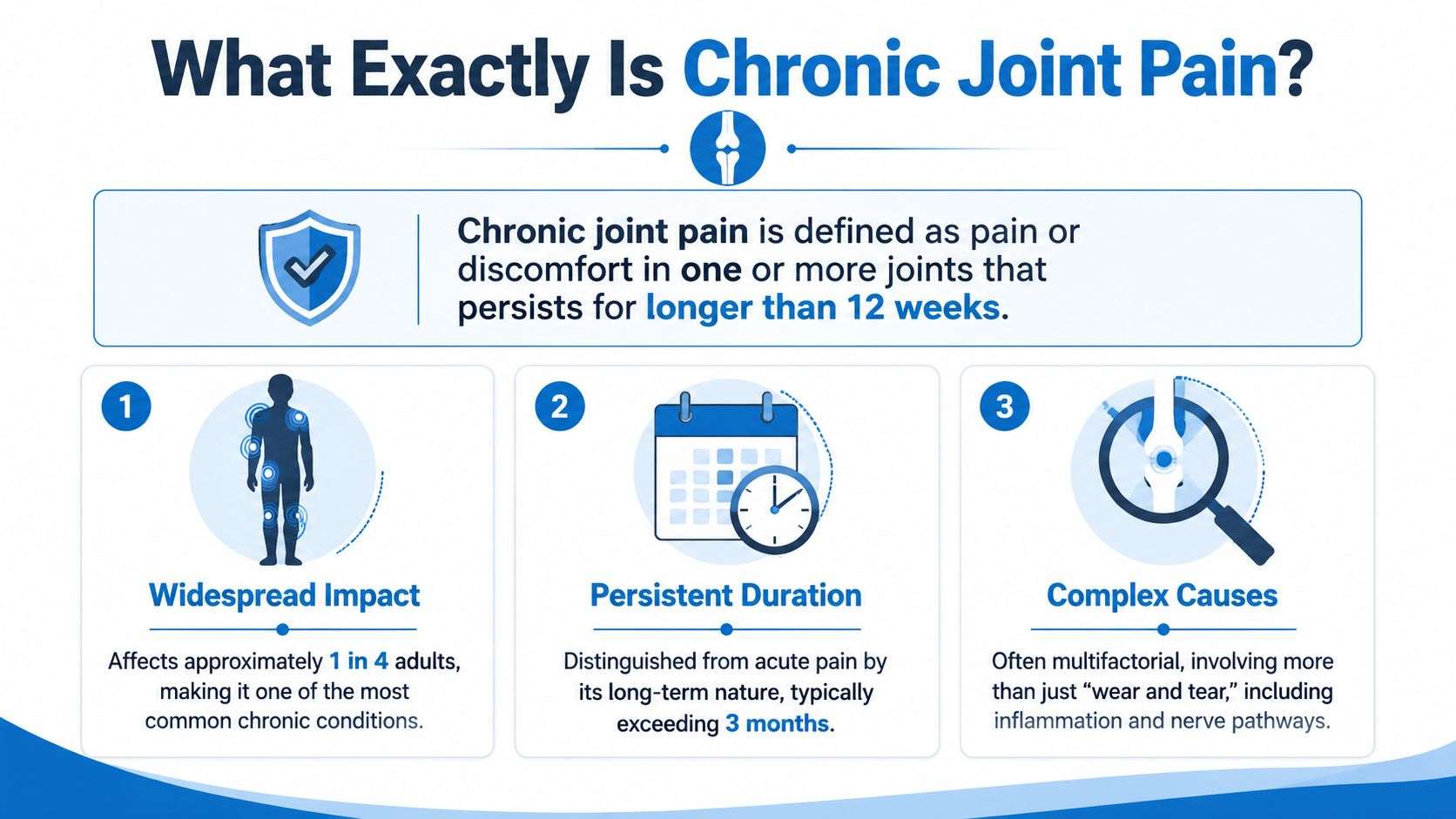
In plain terms, chronic joint pain means a joint, or what feels like a joint, keeps hurting well past the point where you’d expect a simple strain to settle down. Sometimes the cause is straightforward. Often it isn’t. Pain can involve cartilage wear, irritated tendons, inflamed joint lining, movement dysfunction, nerve irritation, or several of those at once.
The scale of the problem is large. The CDC estimates that 58.5 million U.S. adults have doctor-diagnosed arthritis, and about 25.7 million report arthritis-attributable activity limitation according to the CDC arthritis indicator definitions. That doesn’t include every person with chronic joint pain from non-arthritis causes, which means the full burden is even broader than many people realize.
Why it’s so common around Johnson County
In this part of the Kansas City metro, joint pain often builds from ordinary modern routines. Long commutes, desk-heavy jobs, repetitive lifting, recreational sports, previous injuries, and inconsistent exercise all shape how your joints load and recover.
A typical pattern looks like this:
- Too much sitting: Hips stiffen, upper back mobility drops, and the low back starts compensating.
- Weekend overload: You go from sedentary workdays to long walks, yard projects, or sports.
- Old injuries stay in the system: Even if an ankle sprain or back flare happened years ago, your movement pattern may still reflect it.
- Recovery gets overlooked: Sleep, nutrition, stress, and strength work matter more than often realized.
Why the label matters less than the pattern
You may have been told you have arthritis, inflammation, degeneration, tendonitis, or bursitis. Sometimes that’s accurate and useful. Sometimes it’s incomplete.
What matters clinically is whether your pain is acting like a degenerative problem, an inflammatory problem, a mechanical overload problem, or something referred from another region. That distinction changes treatment. It also explains why the same ice pack, brace, or injection that helped someone else may not solve your issue.
What Are the Real Causes of Persistent Joint Pain?
Persistent joint pain usually comes from overlapping drivers, not a single broken part. If you’ve been stuck in a cycle of short-lived relief, this is often the missing piece.
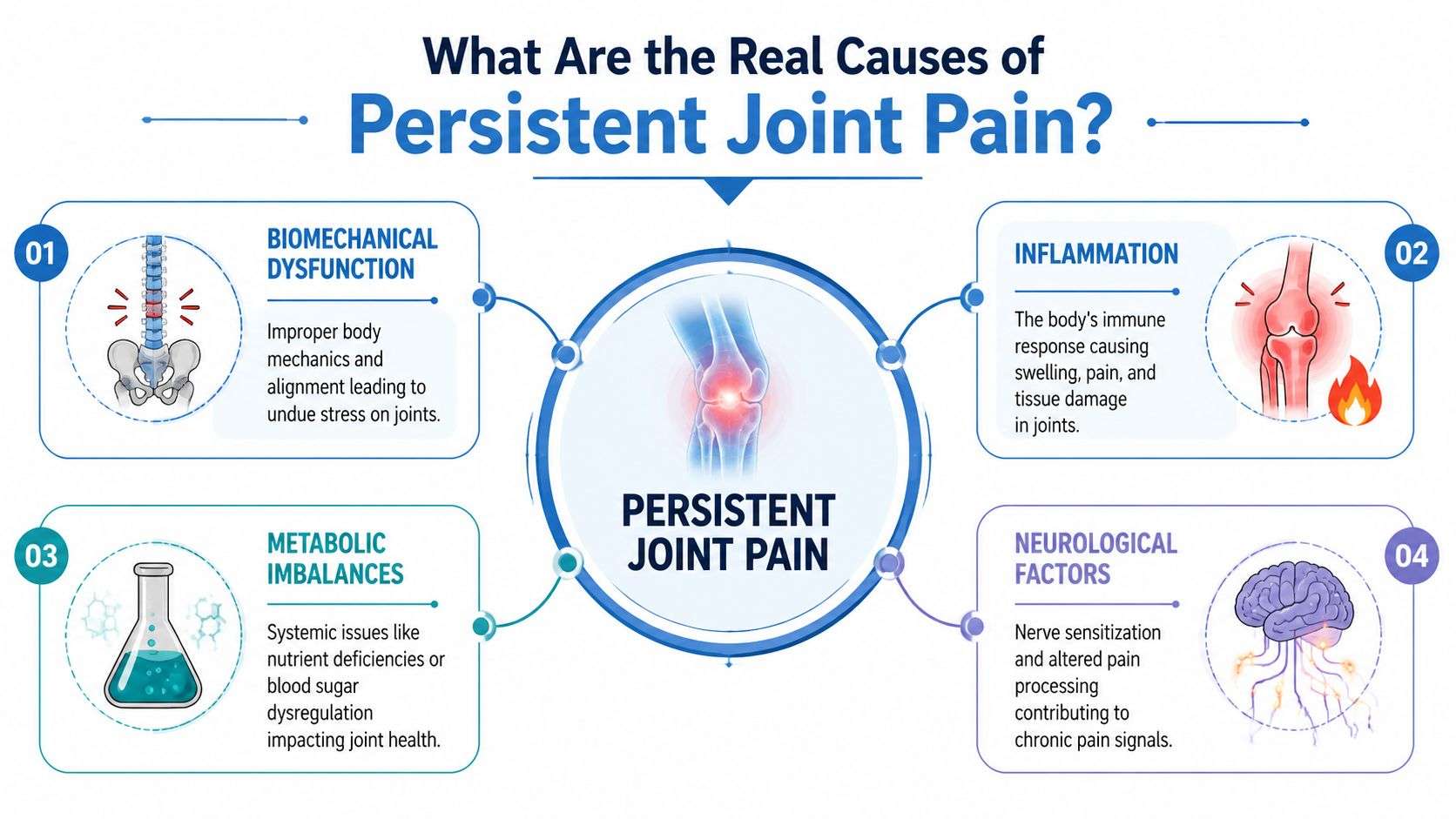
Biomechanical dysfunction changes how force moves through you
Joints need clean motion. When one area stops moving well, another area usually absorbs the extra stress. A stiff ankle can overload the knee. Poor hip rotation can stress the low back. Restricted thoracic spine motion can force the shoulder to do work it wasn’t designed to do.
This is why people can have “joint pain” without dramatic imaging findings. The issue may be less about structural damage and more about how poorly the system is distributing load.
Inflammation can keep pain active
Inflammation isn’t always obvious swelling. It can be a low-grade, persistent irritant that keeps tissue reactive and recovery slow. Local tissue irritation matters, but systemic inflammation matters too.
In suburban patterns common around Lenexa and the southwest KC metro, inconsistent sleep, processed food, stress, low activity during the week, and overdoing activity on weekends can all make joints more reactive.
Your nervous system can become easier to trigger
This part is underexplained in most patient conversations. Joint pain is not just structural. Damaged or irritated joints can release pro-inflammatory cytokines that sensitize nociceptors, which are pain-sensing nerves. That lowers their activation threshold, so the system starts reacting faster and louder. A review in PubMed Central on joint pain mechanisms describes this process, including peripheral sensitization.
A simple way to think about it is this: your pain alarm gets turned up. At first, it responds to clear injury. Later, it can react to smaller inputs that shouldn’t create as much pain.
When pain has been present for a long time, “nothing major showed on the X-ray” doesn’t mean nothing is wrong. It may mean the problem is biochemical, neurological, or movement-based.
Metabolic and autoimmune factors can hide in plain sight
Not all persistent joint pain is classic osteoarthritis. Some cases behave more like inflammatory or autoimmune disease. Others reflect broader metabolic dysfunction that makes tissues more vulnerable and recovery slower.
Cleveland Clinic notes that the major diagnostic fork includes degenerative, inflammatory or autoimmune, and mechanical or overuse causes in its joint pain overview. HSS also points out that autoimmune causes such as rheumatoid arthritis, psoriatic arthritis, and lupus can affect younger adults, especially women, in its overview of joint pain types and causes.
For people who already know arthritis is part of their diagnosis, our clinic also provides educational support around arthritis care.
Why Do So Many Joint Pain Treatments Ultimately Fail?
Most failed treatment stories have one thing in common. The care was fragmented.
You may have gotten an injection from one office, stretches from another, a few adjustments somewhere else, and general advice to rest or lose weight. None of those tools are wrong. The problem is that they often aren’t coordinated around a clear diagnosis of what’s driving your pain.
The pain location can fool you
A detailed primary care review emphasizes that pain felt in a joint can come from the spine or soft tissues, not the joint itself. It specifically notes that vertebral column pain can reflect conditions such as spondyloarthritis or cervical and lumbar spondylosis, and that clinicians need to distinguish true joint disease from nearby sources based on exam pattern and range of motion in this clinical review on polyarticular joint pain.
That means hip pain can be back-driven. Knee pain can be hip-driven. Shoulder pain can be neck-driven. If treatment keeps targeting the symptom location without checking those relationships, relief may be temporary or inconsistent.
Single-focus care has real limits
Here’s where many people get stuck:
| Common approach | What it can help | What it may miss |
|---|---|---|
| Rest and activity avoidance | Calms acute irritation | Loss of strength and stiffer movement patterns |
| Medication only | Reduces symptoms | Mechanical cause, referred pain, or metabolic contributors |
| Joint injection only | Lowers pain for some cases | Instability, weak support muscles, recurring overload |
| Exercise program alone | Builds resilience | Ongoing joint restriction, nerve irritation, or inflammation drivers |
Important distinction: Relief is not the same as resolution. A treatment can reduce symptoms and still leave the underlying driver untouched.
Why comprehensive evaluation matters first
Before deciding what “works,” you need to know which bucket your pain falls into:
- Primarily degenerative: Often gradual, load-related, and linked to joint wear.
- Primarily inflammatory: More swelling, stiffness, multiple joints, or systemic clues.
- Primarily mechanical or referred: Tied to movement patterns, neighboring regions, or spinal involvement.
That diagnostic step is what makes treatment efficient. Without it, people bounce from one reasonable therapy to another without a plan that fits the actual problem.
The LifeWorks Advantage How Our Integrated Approach Solves Joint Pain
The most effective care plans for chronic joint pain are built in layers. You restore movement. You stabilize that movement. You support tissue healing where needed. Then you address the inflammatory and metabolic environment that either helps recovery or fights it.
That’s the logic behind an integrated model.
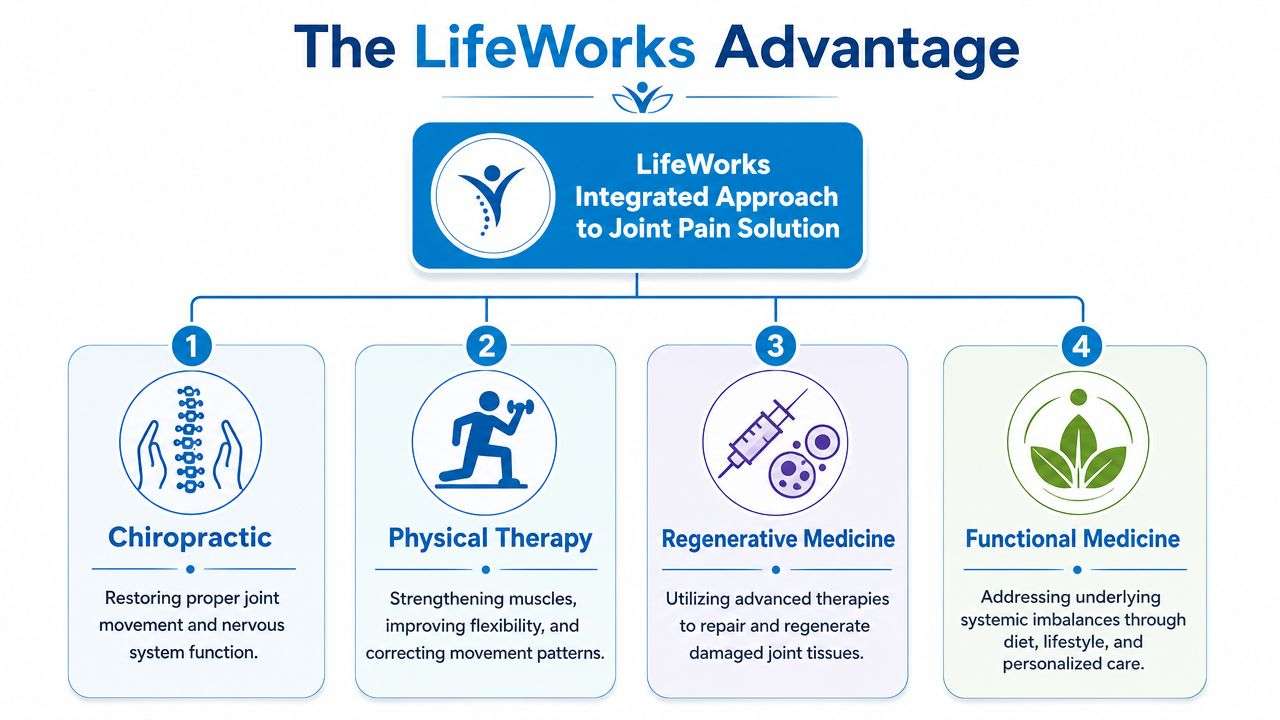
Chiropractic helps restore motion and reduce mechanical stress
When a joint isn’t moving well, nearby tissues often overwork. Chiropractic care can help restore cleaner motion in the spine and extremities, reduce compensatory stress, and improve how your nervous system interprets movement.
That matters because better mechanics create a better starting point. If your pelvis, low back, or thoracic spine are locked up, exercise alone may reinforce compensation instead of fixing it.
For readers looking into options under one roof, LifeWorks Integrative Health offers chiropractic care as part of a coordinated, multidisciplinary setting rather than as a stand-alone symptom visit.
Physical therapy builds durable support
Mobility without stability doesn’t hold. That’s where DPT-led rehabilitation matters. Once painful movement patterns are identified, therapy can retrain strength, balance, joint control, and tissue tolerance.
This is especially useful when your pain came on gradually from desk work, deconditioning, sports, repetitive motion, or an old injury that changed how you move.
A focused rehab plan may include:
- Therapeutic exercise: To strengthen the muscles that unload stressed joints.
- Mobility work: To improve restricted hips, ankles, shoulders, and thoracic spine.
- Movement retraining: To change the gait, squat, reach, or lifting pattern feeding the pain.
- Progressive loading: To rebuild confidence and resilience without flaring symptoms.
Regenerative medicine can support selected cases
Some people also need help at the tissue level, especially when degeneration, chronic irritation, or poor healing capacity are part of the picture. In those cases, therapies such as PRP and Wharton’s Jelly biologics may be considered as adjunctive support within a broader plan. They aren’t magic, and they aren’t right for every patient, but they can be useful when properly selected.
You can learn more about those options through our regenerative medicine services.
Treatment works better when the environment around the joint improves too. Better mechanics, stronger support, and lower inflammatory load give any local therapy a better chance to help.
Functional medicine looks upstream
This is the layer many patients never get. If you keep treating the joint while ignoring systemic drivers, progress often plateaus.
Functional medicine looks at patterns that can influence pain persistence, including blood sugar dysregulation, immune activity, gut issues, recovery capacity, and inflammatory burden. Depending on the case, that may involve deeper evaluation through frameworks and testing such as HOMA-IR, OAT, DUTCH, GI-MAP, ApoB, or GlycA when clinically appropriate.
For someone in Prairie Village or elsewhere in Johnson County with joint pain plus fatigue, digestive issues, brain fog, poor sleep, or widespread stiffness, this can be the difference between symptom management and a more complete plan.
What Can I Do at Home to Support My Recovery?
Home care matters, but it works best when it matches the reason your pain exists. Generic advice like “just rest” or “push through it” usually backfires. You need enough movement to keep the system from stiffening up, without repeatedly provoking irritated tissue.
Focus on calming the terrain
Start with food, hydration, sleep, and daily rhythm. If your joints feel worse after highly processed meals, poor sleep, or stressful stretches at work, pay attention. Those patterns often increase reactivity even when they don’t feel directly related to the painful area.
A practical home foundation includes:
- Build meals around protein and whole foods: This supports tissue repair and steadier energy.
- Prioritize omega-3-rich foods: Fatty fish and similar choices can support a healthy inflammatory response.
- Use colorful plants daily: Polyphenol-rich foods help support recovery.
- Protect sleep: Pain sensitivity usually rises when sleep quality drops.
Dr. Matt’s supplement line at drmattgianforte.com includes categories patients often ask about, such as an omega-3 inflammation-support formula, turmeric-based joint comfort support, magnesium for muscle and nervous system support, and gut-healing protocols when digestive health appears connected to systemic inflammation.
Move every day, but choose the right kind of movement
For individuals with chronic joint pain, the goal is frequent gentle motion, not occasional heroic effort. Controlled mobility and walking often help more than repeated cycles of complete rest followed by intense activity.
Try this framework:
- Morning mobility: Five to ten minutes of easy joint motion can reduce the “rusty” feeling.
- Short walking breaks: Break up long periods of sitting, especially during desk work.
- Gentle strength work: Build support around the painful region without chasing fatigue.
- Downshift your nervous system: Breathing drills, quiet walks, and stress management can reduce pain amplification.
If your pain flares during golf or rotational sports, this resource on understanding golf back pain gives useful context on movement demands that often overlap with hip, back, and joint complaints.
For guided rehab, our physical therapy services are designed to translate those principles into a structured plan.
Your Questions About Joint Pain Treatment Answered
How long does it take to see results from integrative care for joint pain in Overland Park?
It depends on what’s driving the pain. Mechanical problems often start changing once movement quality improves and the right muscles are doing their job again. More complex cases involving longstanding inflammation, referred pain, or metabolic dysfunction usually take a more layered process. What matters most is that the plan matches the cause.
What’s the difference between a chiropractor and a physical therapist for joint pain?
A chiropractor typically focuses on restoring motion, joint mechanics, and nervous system function. A physical therapist focuses on strength, control, endurance, and movement retraining. For chronic joint pain, those roles often complement each other well. If your knee, hip, shoulder, or back pain keeps returning, you usually need both mobility and stability addressed.
Does regenerative medicine actually work for knee pain treatment in Overland Park?
It can be a reasonable adjunct in selected cases, especially when tissue irritation or degeneration is part of the picture. PRP and similar options are not one-size-fits-all, and they work best inside a bigger plan that also improves mechanics and rehab progression. They shouldn’t be presented as a guarantee or a shortcut around strengthening, movement correction, and root-cause evaluation.
When should joint pain make me think about autoimmune disease instead of wear and tear?
Be more alert when pain involves multiple joints, visible swelling, marked stiffness, changes in hand function, or symptoms that seem out of proportion to activity. Younger adults and women should not assume persistent joint pain is just aging. If symptoms are widespread or unusual, a broader workup is warranted rather than repeated symptom-only treatment.
What if my X-rays are normal but my joint still hurts?
That happens more often than people expect. Pain may be coming from soft tissue, the spine, nerve irritation, movement dysfunction, or an inflammatory process that doesn’t show up clearly on basic imaging. Normal imaging does not mean your pain is imaginary. It means the next step should be better clinical reasoning.
Do you help with Federal Workers’ Compensation or repetitive strain cases?
Yes. If your pain relates to repetitive work demands, documentation and coordination matter. Our team has experience supporting OWCP and other work-related cases with the clinical detail these claims often require. That’s especially helpful when chronic joint pain overlaps with neck, back, or repetitive strain patterns.
If you’re driving in from Overland Park and you’re tired of managing symptoms instead of understanding them, LifeWorks Integrative Health is a short drive to our Shawnee clinic at 19701 W 65th Ter, Shawnee, KS 66218. Call 913-441-2293 or schedule a free consultation. Dr. Matthew Gianforte, DC, and our team look at the whole picture, not just the part that hurts.


