
By Dr. Matt Gianforte, DC · LifeWorks Integrative Health, Shawnee, KS
You went to bed feeling fine. Then the alarm goes off, you roll over, and your lower back lets you know it’s there. Getting out of bed turns into a slow, careful project.
By the time you’ve had a shower and a cup of coffee, it’s often better. So what’s going on? In this article I’ll walk you through the common reasons for back pain in the morning, the one pattern that deserves a medical check, simple habits that may help, and when it’s time to get it looked at.
- Some stiffness after a night of lying still is common. Your body isn’t built to stay in one position for hours.
- Your bed and your sleep position matter. A sagging mattress or a twisted position can pull your spine out of line overnight.
- Wear and tear in the discs and joints can show up as morning pain. These changes are common as we get older.
- Long-lasting stiffness that eases with movement is a different story. That pattern can point to an inflammatory condition and is worth a medical check.
- Morning back pain that keeps coming back deserves answers, not years of “just live with it.”
“Why Does My Back Hurt When I Wake Up?”
It’s one of the most common things people ask about. Their back is stiff and sore first thing in the morning, then it loosens up as the day goes on. Some feel it only when getting out of bed. Others feel it for an hour or more.
You’re not imagining it, and you’re not alone. The National Institute of Arthritis and Musculoskeletal and Skin Diseases (NIAMS) calls back pain one of the most common medical problems in the United States. It also lists stiffness in the morning when you wake up, with pain that eases as you move, as a common back pain symptom.
Here’s what I need you to know. Morning back pain is a clue. How long it lasts, what makes it better and what else comes with it all help point to the reason.
What Happens to Your Back Overnight
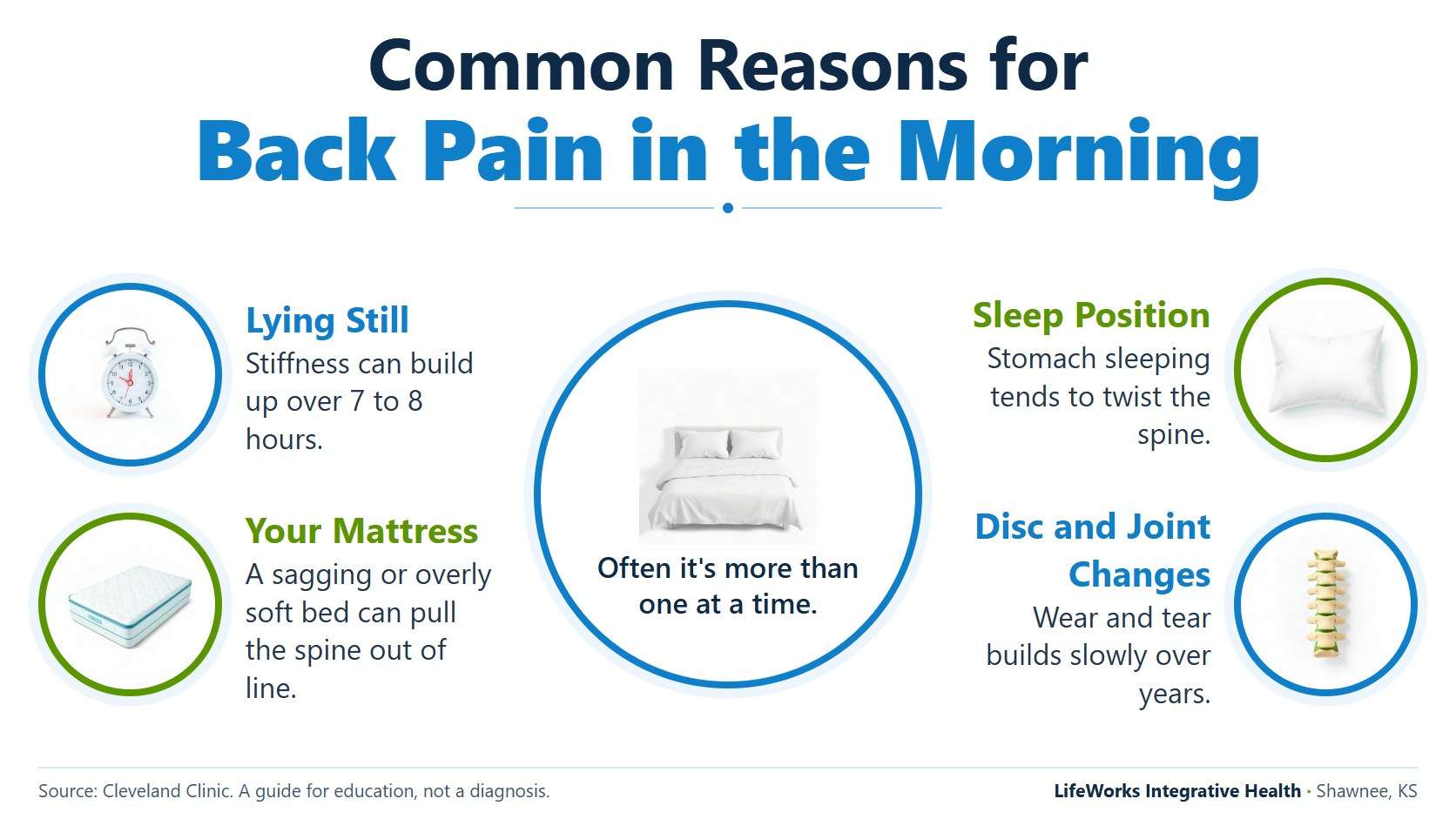
You see, sleep is the longest stretch of time most of us spend without moving. Cleveland Clinic explains that stiffness and inflammation can build up when you lie still for 7 to 8 hours. One of their spine experts put it simply: our bodies aren’t meant to stay still for hours at a time.
When you finally get up, those stiff muscles and joints have to start working all at once. That first bend to put on socks can feel like a lot. For many people, that’s the whole story, and things loosen up once they get moving.
But the position you held all night matters too. If your spine spent hours twisted or sagging, the muscles and joints around it feel that in the morning.
Common Causes of Back Pain in the Morning
Most morning back pain comes from a handful of everyday causes. Often it’s more than one at a time.
Your mattress
Cleveland Clinic notes that a damaged, sagging or overly soft mattress can let your lower body sink and pull your spine out of line. They suggest replacing a mattress every six to eight years, or sooner if it sags, makes noise or leaves you stiff.
What kind of mattress? A 2021 review of 39 studies in the Journal of Orthopaedics and Traumatology found that a medium-firm mattress promotes comfort, sleep quality and spinal alignment. The authors also noted that research doesn’t fully agree on which mattress prevents back pain, so comfort and your own body still matter.
Your sleep position
Cleveland Clinic says the friendliest positions for your back are on your side with your knees partly bent, or on your back if you don’t have sleep apnea. Stomach sleeping tends to twist the neck and pull the spine out of alignment.
Your pillow
The right pillow keeps your neck in line with the rest of your spine. A pillow between your knees when you sleep on your side helps keep the hips and spine lined up too.
Disc and joint changes
Your spinal discs are the cushions between the bones. Cleveland Clinic lists degenerative disc disease and herniated discs as possible contributors to morning back pain. It also reports that spinal arthritis affects up to 95% of people ages 60 and older.
That didn’t show up out of nowhere. Disc and joint changes build slowly over years. If a disc problem is part of your picture, our guide to disc herniation treatment explains the options.
Causes People Miss
And I say this with zero judgment: a lot of morning back pain gets set up during the day, not just at night.
- Long hours of sitting. NIAMS lists desk work with poor posture as a back pain risk factor. If sitting already bothers you, read our article on why it hurts to sit down.
- Weak core muscles and low fitness. NIAMS lists both as risk factors.
- Doing too much after doing too little. The weekend yard project after a quiet week is a classic one. NIAMS lists overexertion after a period of inactivity as a risk factor.
- Poor sleep. According to NIAMS, chronic poor sleep is a risk factor and can make back pain more frequent and more severe.
- Extra weight. NIAMS lists weight gain and obesity as risk factors too.
Think of it like your car. A mechanic has to look under the hood before fixing the engine. Changing the mattress might help, but if weak hips and a long desk day are the real drivers, a new bed won’t touch that.
Practical rule: If your back hurts every morning, look at both your night and your day. The bed is only one piece of the picture.
When Morning Stiffness Points to Inflammation
Here’s the pattern I don’t want anyone to ignore. Most mechanical back pain feels better with rest. Inflammatory back pain often does the opposite.
According to NIAMS, ankylosing spondylitis, a type of arthritis that inflames the spine, most commonly causes lower back or hip pain and stiffness. That pain typically gets worse with rest or inactivity and improves with movement and exercise. Pain may be worse in the middle of the night, and most people notice symptoms before age 45.
Researchers look for a few specific clues. A 2011 study in the Annals of the Rheumatic Diseases screened back pain patients for morning stiffness lasting more than 30 minutes, improvement with movement but not rest, and waking in the second half of the night because of back pain, among other features.
None of these clues proves anything on its own. But if your back is stiff for a long time every morning, wakes you in the early hours, and loosens up only once you move, that’s a pattern to bring to a medical provider. A provider can sort this out with an exam, blood work and imaging, and may refer you to a rheumatologist, a doctor who specializes in arthritis.
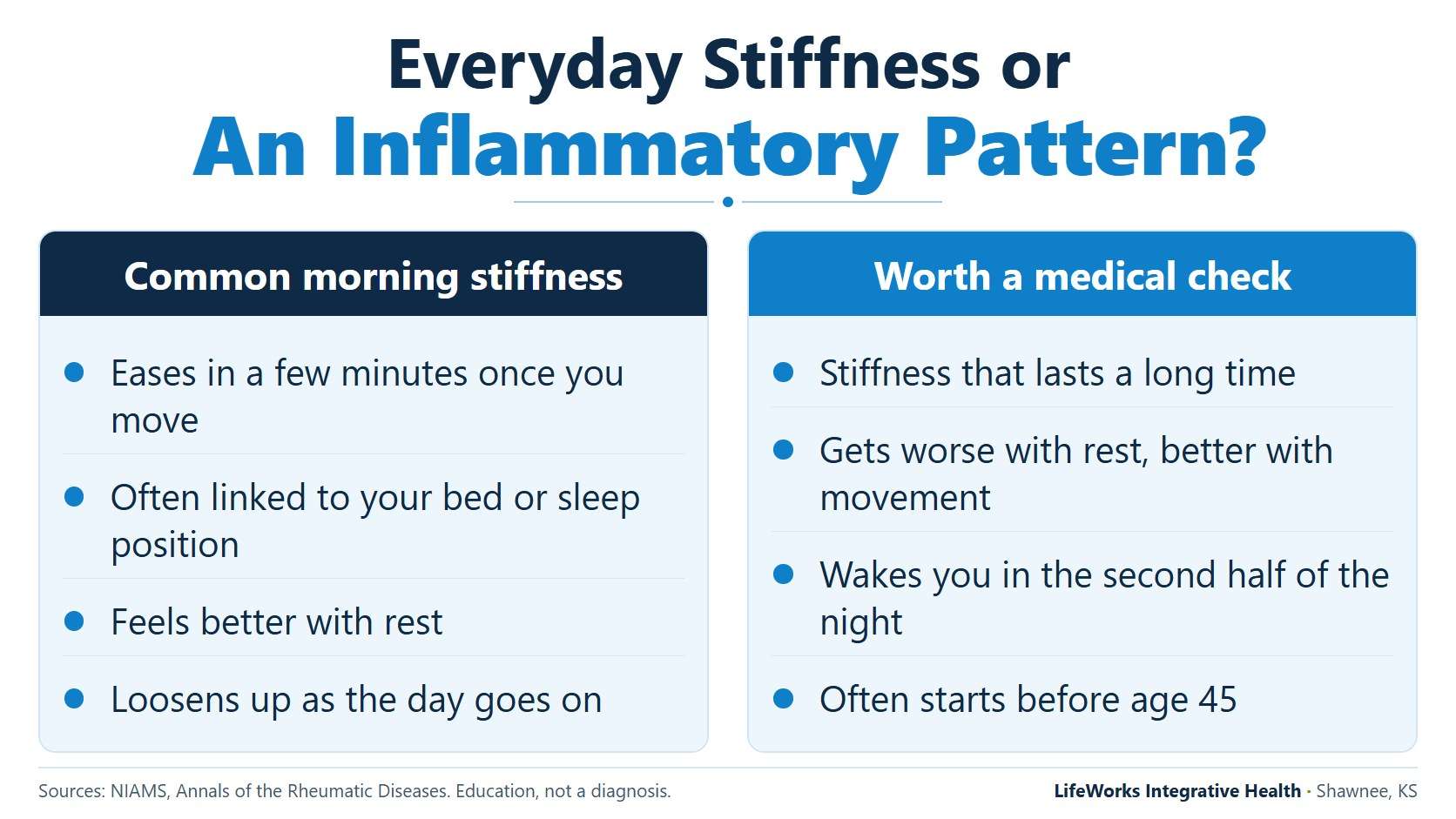
Clinical takeaway: Stiffness that eases in a few minutes after you get moving is common. Stiffness that lasts a long time, comes with night pain and improves with exercise rather than rest deserves a medical check.
How LifeWorks Integrative Health Looks at Morning Back Pain
I opened LifeWorks Integrative Health in 2005 as a chiropractic office for back, neck and knee pain. Over the years we brought chiropractic, physical therapy and medical providers under one roof, so we can look at the whole picture instead of just the sore spot.
When someone comes to us with back pain that’s worst in the morning, we start by asking questions. How long does the stiffness last? What makes it better? Does it wake you up? Is there numbness, tingling or leg pain?
Then we examine how your spine, hips and core move. Depending on what we find, care may include chiropractic care to help joints move better, physical therapy to build strength and mobility, and help with sleep setup and daily habits.
If the story sounds inflammatory, or if we see a red flag, we’ll tell you and point you toward the right medical testing. Not every case needs imaging, and our article on when to get an MRI for back pain explains when it makes sense.
What You Can Do at Home
Don’t aim for perfect. Aim for better. These small changes are easy to try and may take the edge off your mornings.
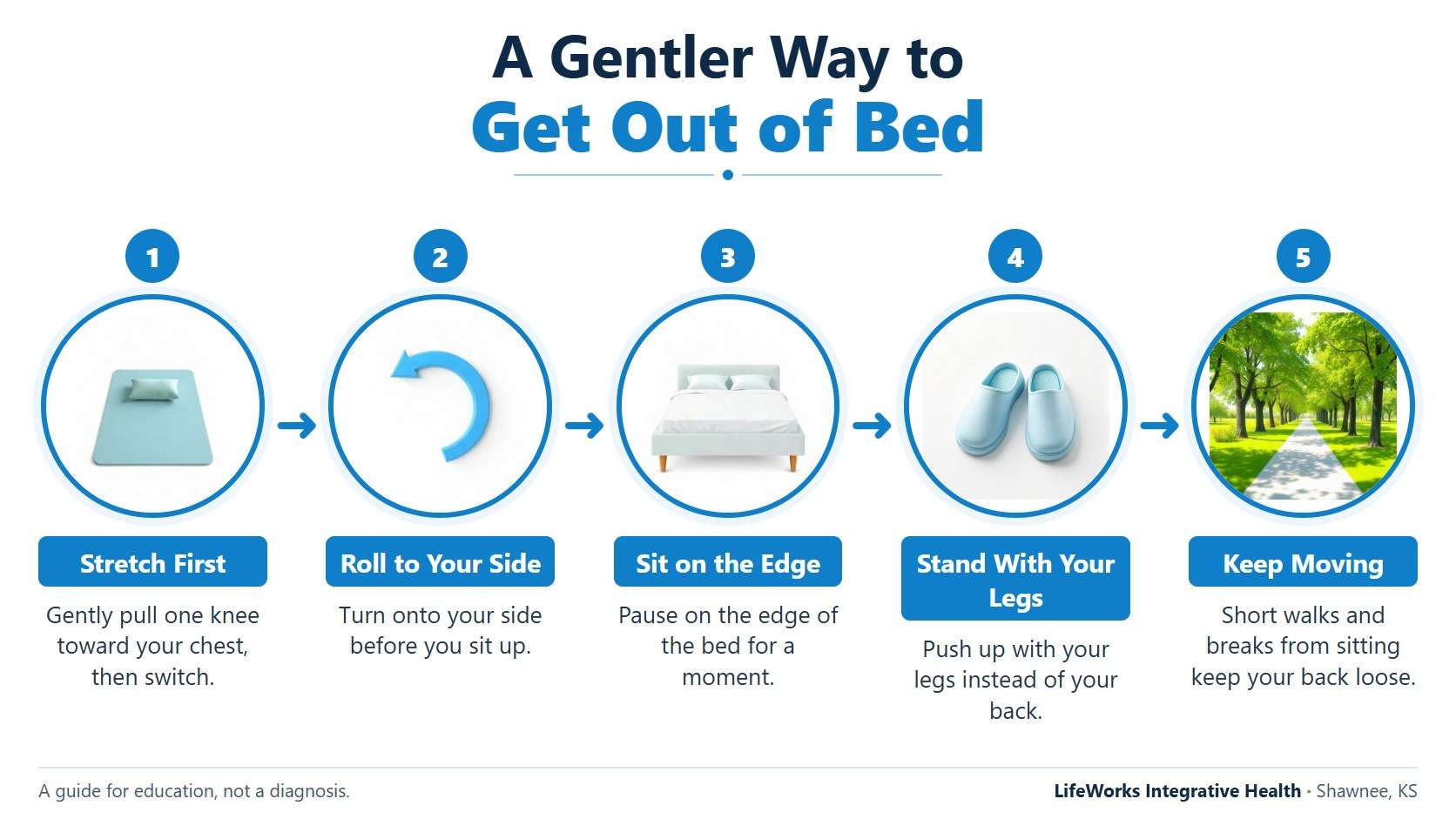
- Stretch before you stand. Cleveland Clinic suggests lying on your back and gently pulling one knee toward your chest, holding for a few seconds, then switching legs.
- Get up the smart way. Roll to your side, sit on the edge of the bed, then stand using your legs instead of your back.
- Use pillows to support your spine. MedlinePlus suggests a pillow between your legs when you sleep on your side, or a pillow or rolled towel under your knees when you sleep on your back.
- Check your mattress. If it sags or is older than six to eight years, it may be time for a new one. Cleveland Clinic suggests a medium-firm feel.
- Keep moving during the day. MedlinePlus notes that bed rest isn’t recommended for back pain. Short walks and breaks from sitting help your back stay loose.
- Build your core. NIAMS recommends building core strength to help protect your back. Our guide to back and neck pain stretches is a good place to start.
For new back pain after a strain, MedlinePlus suggests ice for the first 48 to 72 hours and then heat. If you use a heating pad, Cleveland Clinic recommends one with an auto shutoff and a layer of fabric between it and your skin.
When to Get Help and Red Flags
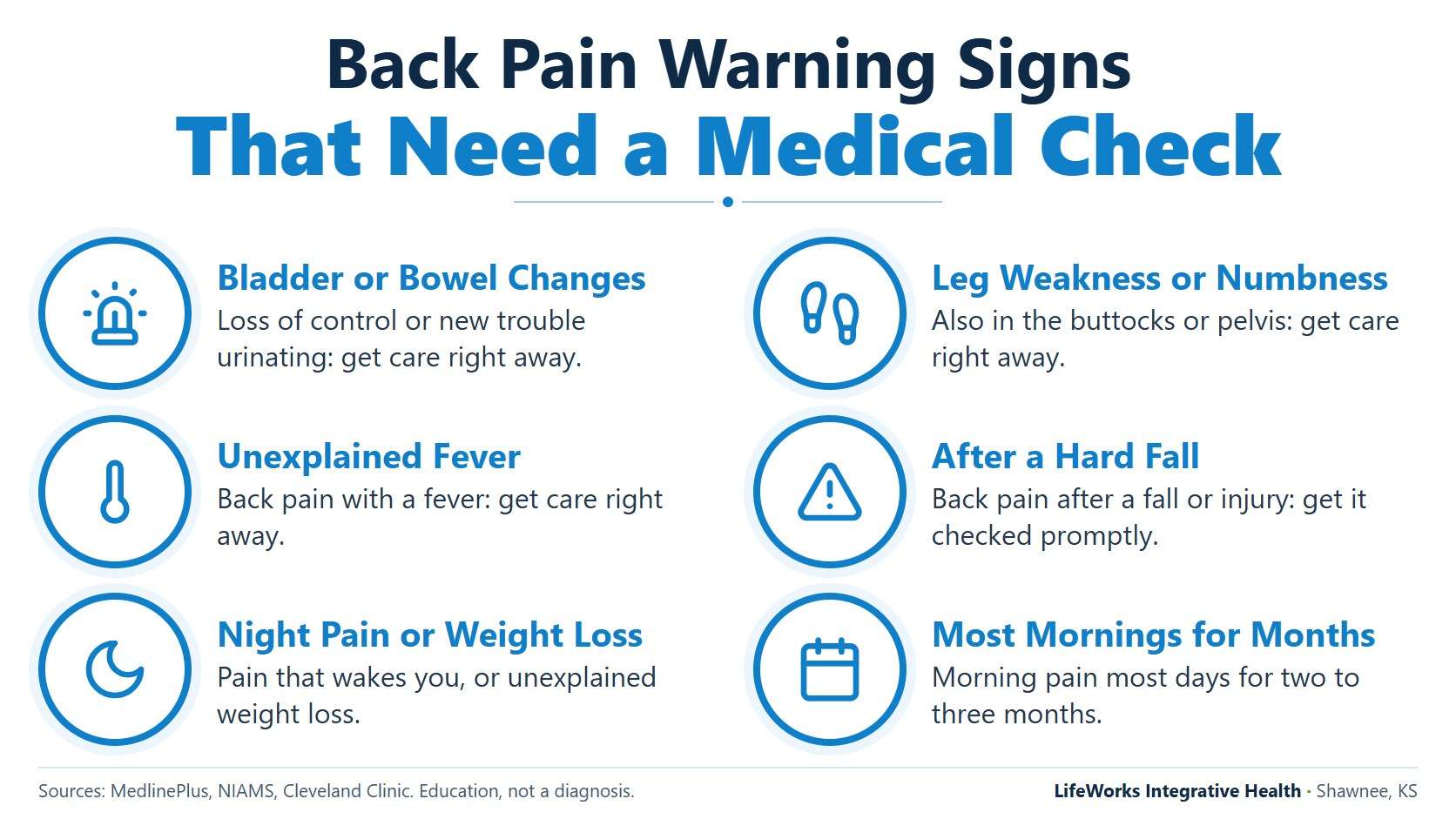
Cleveland Clinic advises seeing a provider if your back pain is getting worse, or if it happens most mornings for two or three months. Please don’t wait six months hoping it goes away.
Some signs need attention right away. MedlinePlus and NIAMS list these warning signs.
| What you notice | What to do |
|---|---|
| Loss of bladder or bowel control, or new trouble urinating | Get medical care right away |
| Weakness or numbness in the legs, buttocks or pelvis | Get medical care right away |
| Back pain with an unexplained fever | Get medical care right away |
| Back pain after a hard fall or injury | Get it checked promptly |
| Pain that wakes you at night, or unexplained weight loss | Make an appointment soon |
| Long morning stiffness that improves with movement | Ask about inflammatory back pain |
| Morning pain most days for two to three months | Have your back evaluated |
Common Questions About Back Pain in the Morning
Why does my back hurt in the morning but feel better as the day goes on?
Often it’s stiffness from lying still for hours, plus your mattress and sleep position. Moving warms up the muscles and joints. If the stiffness lasts a long time every morning, though, have it checked for an inflammatory cause.
Can a bad mattress cause back pain in the morning?
It can contribute. A sagging or overly soft mattress can let your spine sag out of line overnight. A 2021 review found medium-firm mattresses support comfort, sleep quality and spinal alignment.
What is the best sleeping position for morning back pain?
Cleveland Clinic suggests sleeping on your side with your knees partly bent and a pillow between them, or on your back with a pillow under your knees if you don’t have sleep apnea. Stomach sleeping tends to twist the spine.
Why does my back hurt when I get out of bed?
Getting up asks stiff muscles and joints to bend, twist and carry weight all at once. Stretching in bed first, then rolling to your side and pushing up with your arms and legs, puts less strain on your back.
Should I worry about back pain every morning?
Not always, but it’s worth attention. If it happens most mornings for two or three months, gets worse, wakes you at night or comes with numbness or weakness, see a provider.
You deserve more than “just live with it.” If your back makes every morning a slow start, we can look at how your spine moves, what’s driving the stiffness and what you can change, all under one roof. Call (913) 441-2293 or book an appointment online. Let’s look at it together. Our clinic is at 19701 W 65th Terrace, Shawnee, KS 66218, and we’re rated 5.0 across more than 150 Google reviews.
Sources
- National Institute of Arthritis and Musculoskeletal and Skin Diseases. Back Pain.
- National Institute of Arthritis and Musculoskeletal and Skin Diseases. Ankylosing Spondylitis.
- Cleveland Clinic. Why Is My Back Pain Worse in the Morning?
- Caggiari G, et al. What type of mattress should be chosen to avoid back pain and improve sleep quality? Review of the literature. Journal of Orthopaedics and Traumatology, 2021.
- Braun A, et al. Identifying patients with axial spondyloarthritis in primary care: how useful are items indicative of inflammatory back pain? Annals of the Rheumatic Diseases, 2011.
- MedlinePlus. Low back pain, acute.
This article is for education and isn’t medical advice. Talk with your own provider about your situation.