By Dr. Matt Gianforte, DC · LifeWorks Integrative Health, Shawnee, KS
Your feet tingle, burn or feel like they’re wrapped in cotton. A friend says, “Go see a chiropractor, they helped my back.” So you wonder: can a chiropractor help neuropathy, too?
I’m a chiropractor, and I’ve run LifeWorks Integrative Health since 2005. So you might expect me to say yes to seeing a chiropractor for neuropathy. The honest answer is “it depends on what’s actually causing your symptoms,” and in this article I’ll show you exactly what I mean.
- “Neuropathy” and a pinched nerve are not the same thing. Damage to the nerves in your feet and hands is different from a nerve being squeezed near your spine, even though they can feel alike.
- A chiropractor may help when the spine is part of the problem. Research supports spinal manipulation for some back and neck pain, which can come with leg or arm symptoms.
- The evidence for adjustments in true peripheral neuropathy is limited. Anyone who promises that adjustments alone will solve nerve damage in your feet is overselling it.
- The cause has to be found first. Diabetes, low vitamin B12, alcohol and other problems can damage nerves, and those need medical attention.
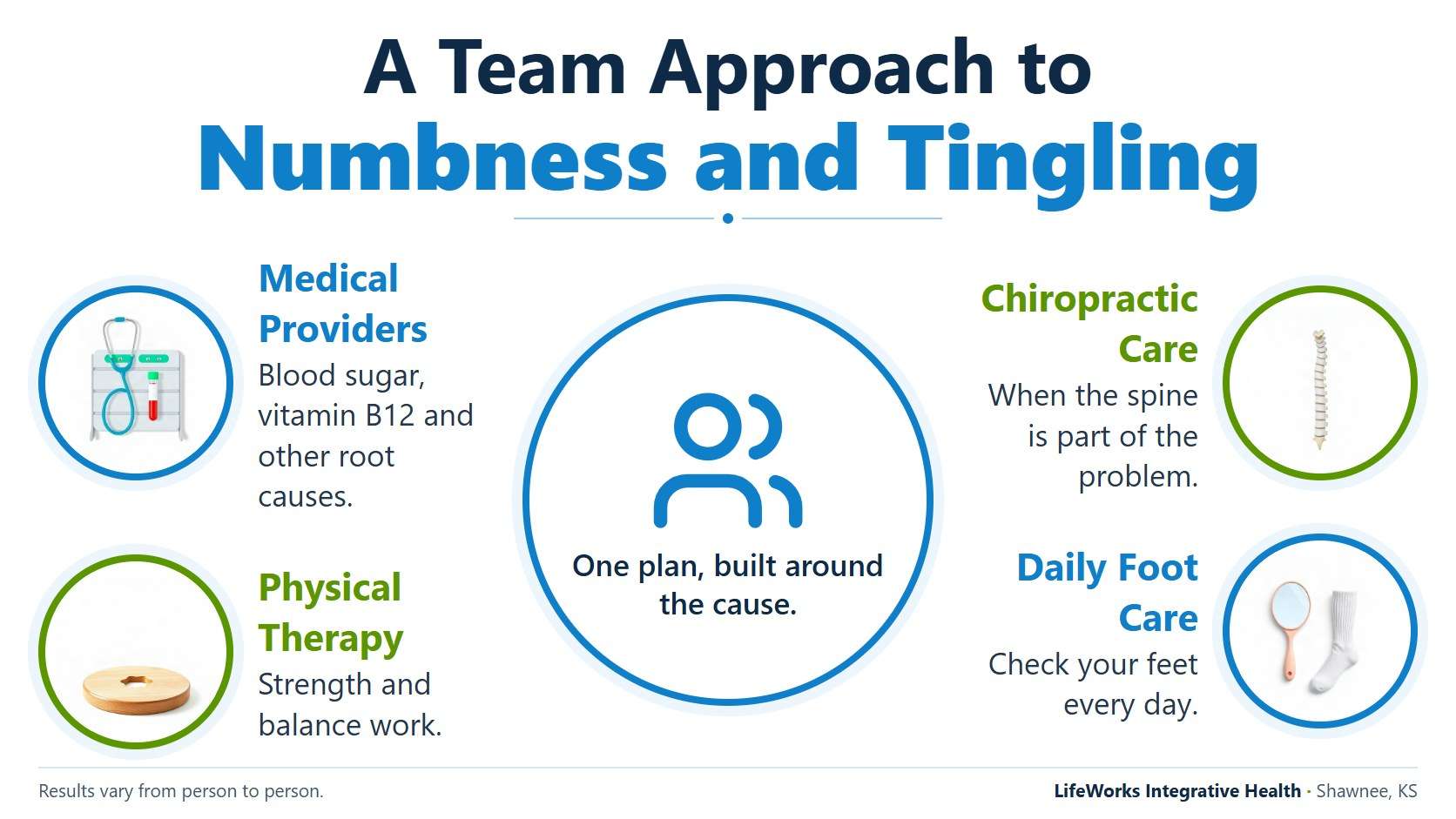
- A team approach makes the most sense. Chiropractic, physical therapy and medical providers working together can cover more of the picture than any one of them alone.
Why People Ask a Chiropractor About Neuropathy
Most people don’t search “can a chiropractor help neuropathy” out of curiosity. They search it because they’ve been told to live with it, or because the pills made them foggy and the numbness is still there.
That’s a fair place to be. And I say this with zero judgment: it’s also a place where people get sold a lot of promises. So let’s slow down and look at what’s really going on inside those nerves.
Here’s what I need you to know up front. “Neuropathy” gets used as a catch-all for numbness, tingling and burning. But two very different problems can cause those feelings, and the right care depends on which one you have. Sometimes it’s both.
Peripheral Neuropathy vs. a Pinched Nerve
You see, a nerve is a lot like a lamp cord. If the cord is frayed along its length, the light flickers. If the cord is kinked where it leaves the wall, the light flickers too. Same flicker, very different repair.
Peripheral neuropathy: the frayed cord
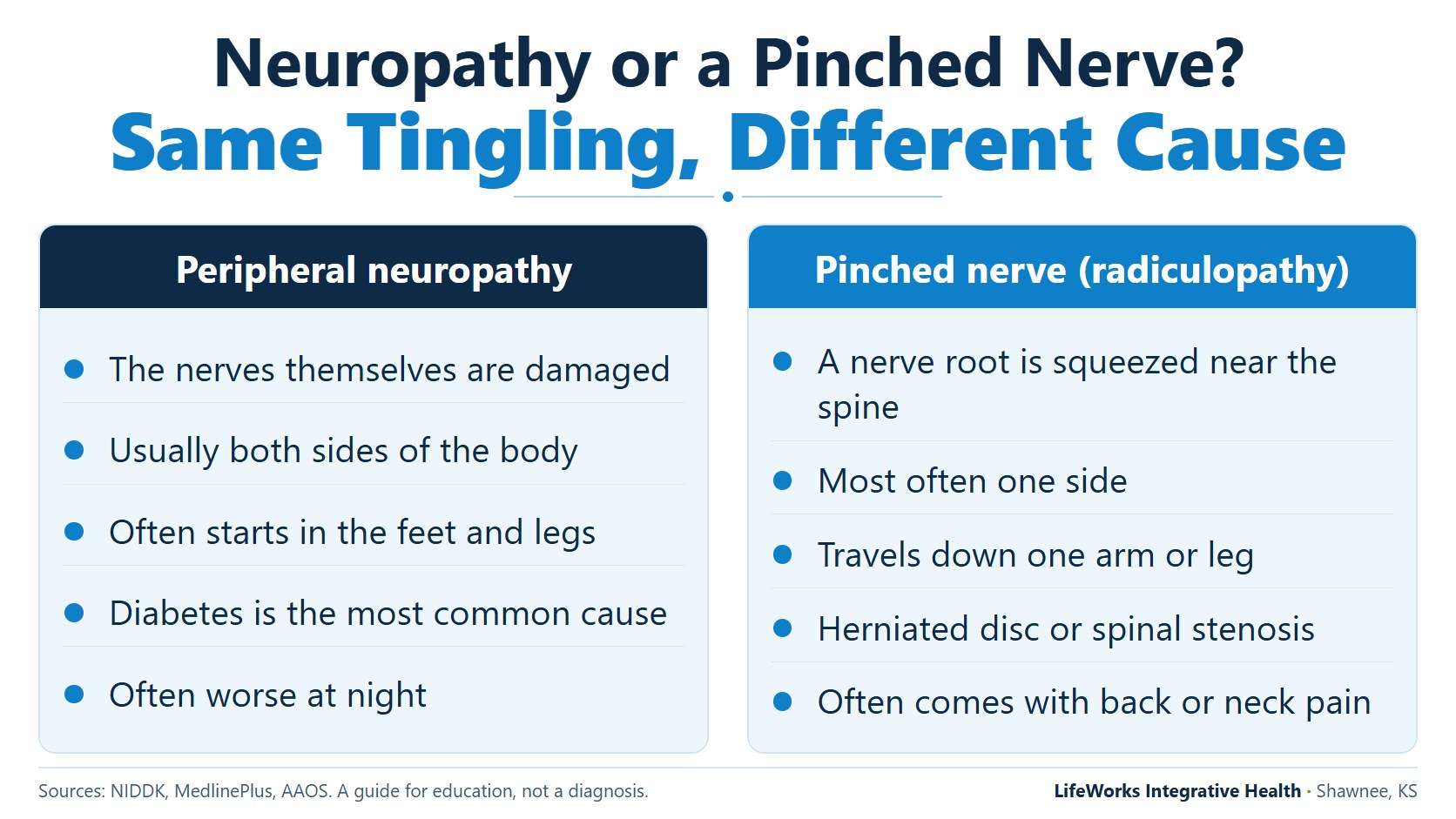
Peripheral neuropathy means the nerves themselves are damaged, usually out in the feet and legs first. According to MedlinePlus from the National Library of Medicine, diabetes is the most common cause, and others include low levels of vitamins B1, B6 or B12, kidney disease, autoimmune disorders, certain infections and long-term heavy alcohol use. MedlinePlus also notes that often no cause is found.
It’s common, too. According to the National Institute of Diabetes and Digestive and Kidney Diseases (NIDDK), up to one-half of people with diabetes have peripheral neuropathy. The NIDDK says it typically affects both sides of the body and is often worse at night.
Radiculopathy: the kinked cord
Radiculopathy is the medical word for a nerve root that’s squeezed or irritated where it leaves the spine. The American Academy of Orthopaedic Surgeons (AAOS) explains that a pinched nerve in the neck can cause pain that travels down the arm, along with tingling, numbness or weakness in the hand. In the low back, MedlinePlus describes sciatica as pain, weakness, numbness or tingling in the leg, most often on one side, from causes like a herniated disc or spinal stenosis.
If you’re still sorting out what’s behind your symptoms, our guide to what causes numbness and tingling in the feet walks through the common culprits.
Clues That Point to the Spine
Only an exam can tell you for sure. But in our clinic, a few patterns make us look harder at the spine.
- Symptoms on one side. MedlinePlus notes that sciatica pain most often shows up on one side of the body. Diabetic neuropathy, by contrast, usually affects both sides, according to the NIDDK.
- Back or neck pain that comes with it. Leg symptoms that flare with back pain, or arm symptoms that flare with neck pain, raise the question of a nerve root.
- Symptoms that change with position. If sitting, bending or turning your head changes the tingling, that’s worth noting for your provider.
- A path you can trace. AAOS describes pinched nerve pain that starts at the neck and travels down the arm in the area that nerve serves.
Here’s the tricky part. Someone can have diabetic neuropathy in both feet and a pinched nerve in the low back at the same time. That’s why the evaluation matters more than the label.
Practical rule: Numbness in both feet points more toward the nerves themselves. Symptoms on one side that come with back or neck pain point toward the spine. Many people need both checked.
What the Evidence Says About Chiropractic Care
This is where I want to be really honest with you, because you deserve answers, not a sales pitch.
Where spinal manipulation has support
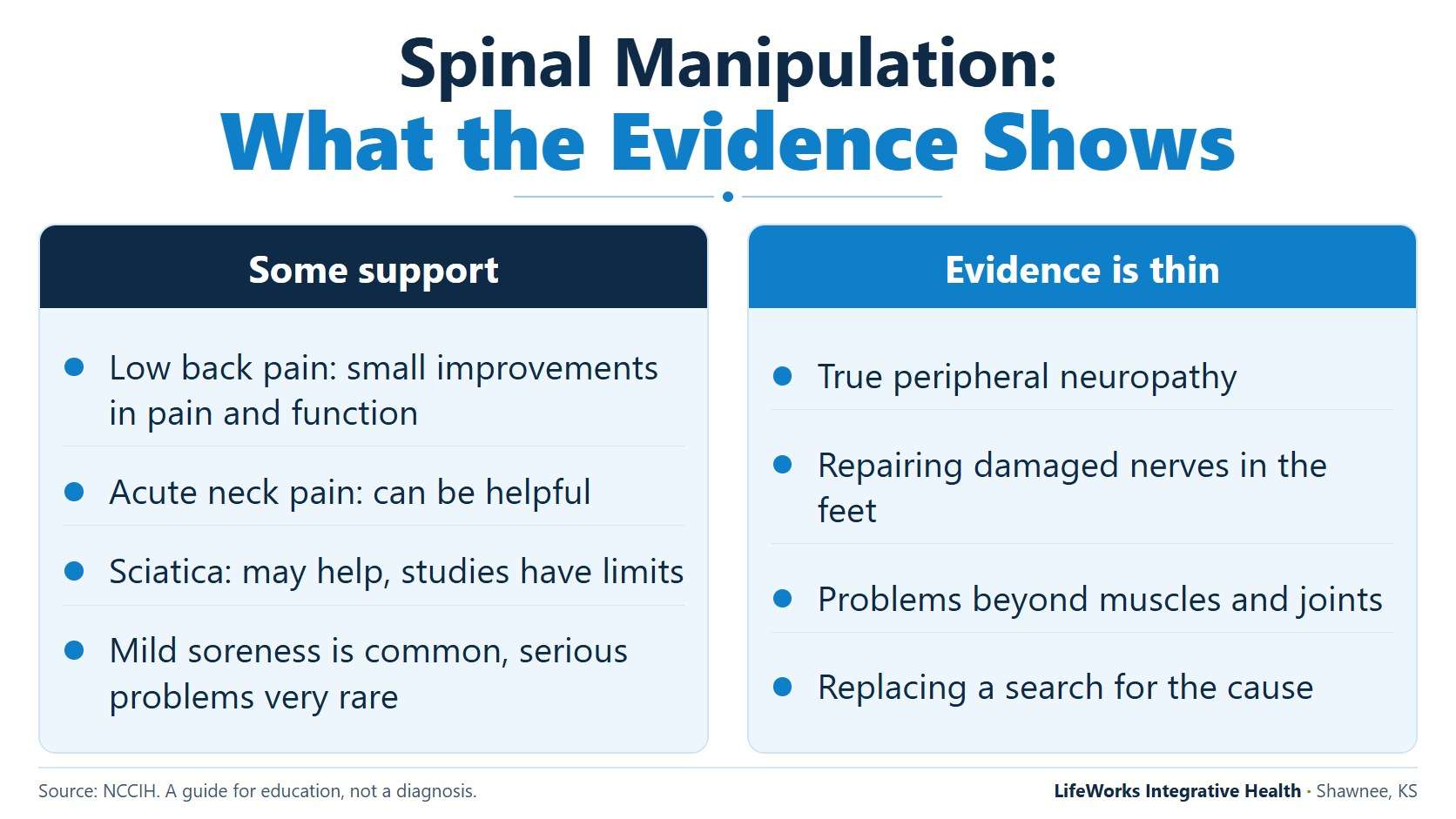
The National Center for Complementary and Integrative Health (NCCIH) reports that spinal manipulation may lead to small improvements in both pain and function for low back pain, and can be helpful for acute neck pain. For sciatica, NCCIH says manipulation may help, but the studies have limitations.
So if part of your tingling is coming from an irritated nerve root in your back or neck, chiropractic care may be a reasonable piece of the plan.
Where the evidence is thin
For true peripheral neuropathy, the nerve damage itself, there isn’t good-quality research showing that spinal adjustments help. NCCIH notes that only a small amount of high-quality research exists on spinal manipulation for conditions beyond muscle and joint problems.
That doesn’t mean a chiropractor has nothing to offer someone with neuropathy. Balance, joint motion in the feet and ankles, and back pain that makes walking harder can all be worth working on. It means adjustments alone shouldn’t be sold as the answer to damaged nerves.
Safety
NCCIH says mild side effects like soreness, stiffness or headache are common and usually go away within 24 hours, while serious problems are very rare. It also notes the chance of a serious side effect may be higher in people with underlying health problems, so share your full health history and medicines with whoever treats you.
Clinical takeaway: Chiropractic care is a tool for the spine and joints. It’s a good tool when the spine is involved. It’s not a replacement for finding out why the nerves in your feet are damaged.
Why a Team Approach Matters for Neuropathy
I opened LifeWorks Integrative Health in 2005 as a chiropractic office for back, neck and knee pain. Around 2012 I kept seeing problems adjustments alone couldn’t touch. So we brought medical providers, physical rehab and chiropractic under one roof.
Neuropathy is a great example of why. MedlinePlus says treating the underlying cause is the first step, which may mean controlling blood sugar, stopping alcohol, adjusting medicines or taking vitamins. That’s medical work. The NIDDK lists physical therapy as part of care, and it’s where the research on strength and balance is strongest, as we explain in our article on physical therapy for neuropathy.
And if a nerve root in the spine is part of the story, that’s where chiropractic care fits.
The case that changed our clinic
Back in 2014, a young woman came to us with neuropathy. She’d had two failed surgeries and was taking opioids every day. Our first plan didn’t work.
We refused to tell her “we can’t help.” We went back to the research, found newer protocols being used in Europe, and called her back for a do-over. Over time she was able to get off the medication. Results vary from person to person, but that case taught us to keep asking why.
How We Evaluate Numbness and Tingling at LifeWorks
You have to look under the hood before you fix the engine. Here’s how we approach it.
- Listen to the history. When it started, where it is, one side or both, and what else is going on, like diabetes or medicines.
- Examine the nerves. Sensation, reflexes, strength and balance. The NIDDK describes exams that can include a tuning fork, a nylon strand test and a check of how you walk.
- Check the spine. Movement, posture and signs that a nerve root is involved.
- Look for root causes. According to the NIDDK, blood tests can check for problems like thyroid disease, kidney disease or low vitamin B12.
- Build the plan as a team. Chiropractic, physical therapy and medical care, each where it fits.
Our neuropathy care and our chiropractic care work side by side, so you’re not bouncing between offices. For more on the testing side, see how peripheral neuropathy is diagnosed. If the spine turns out to be the main driver, our guide to pinched nerve relief covers what that care looks like.
What You Can Do at Home
Don’t aim for perfect. Aim for better. These simple habits help no matter what’s behind your symptoms.
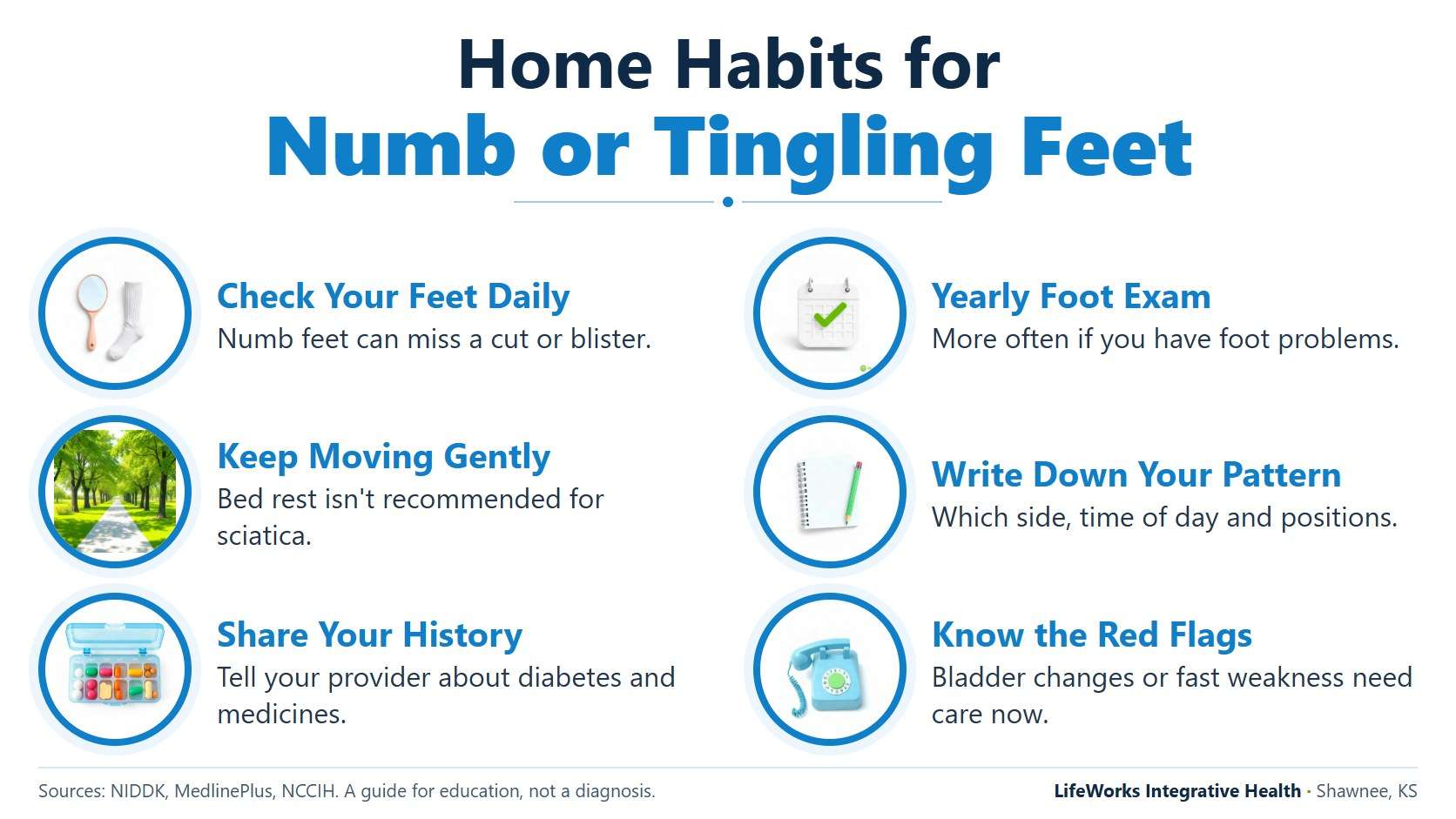
- Check your feet every day. The NIDDK recommends it, because numb feet can miss a cut or blister.
- Get a yearly foot exam. The NIDDK advises a foot exam at least once a year, more often if you have foot problems.
- Keep moving gently. MedlinePlus says bed rest isn’t recommended for sciatica, and gentle movement is encouraged early on.
- Write down your pattern. Note which side, what time of day and what positions make it better or worse. It helps your provider a lot.
Red Flags: When Not to Wait
Some symptoms need prompt medical care, not a chiropractic visit first. Call your doctor, or get emergency care, if you notice any of these.
| What you notice | Why it matters |
|---|---|
| Loss of control of urine or stool | MedlinePlus lists this as a reason to contact a provider right away with back and leg symptoms |
| Weakness or numbness in the buttocks, thigh, leg or pelvis | It can mean a nerve is under serious pressure |
| Back pain with an unexplained fever, or after a hard fall | These need a medical workup before any hands-on care |
| A foot sore, blister or cut that isn’t healing | The NIDDK advises calling your doctor right away about foot problems |
| Symptoms that spread or worsen quickly | Fast changes need a medical evaluation |
Common Questions About Chiropractic Care for Neuropathy
Can a chiropractor help neuropathy in your feet?
If the feet are affected because of a nerve root problem in the low back, chiropractic care may help as part of a plan. If it’s peripheral neuropathy from diabetes or a vitamin problem, the evidence for adjustments is limited, and the cause needs medical care. A good evaluation tells you which you’re dealing with.
Can a chiropractor help neuropathy pain?
Research supports spinal manipulation for some low back and neck pain, according to NCCIH. For nerve pain from peripheral neuropathy itself, there isn’t good evidence that adjustments help. Pain from neuropathy is usually managed by addressing the cause, along with other treatments your medical provider may suggest.
Can a chiropractor tell if it’s neuropathy or a pinched nerve?
A chiropractor can examine your spine, reflexes, strength and sensation, and that often points in the right direction. Some cases need blood work, nerve testing or imaging too. That’s one reason we like having medical providers under the same roof.
Is chiropractic care safe if I have neuropathy?
For most people, yes, with the right precautions. NCCIH says serious side effects are very rare but may be more likely in people with underlying health problems. Tell your chiropractor about diabetes, blood thinners and any other conditions.
Should I see a chiropractor or a medical doctor first?
If you have red flags like bladder changes or fast-spreading weakness, see a medical provider right away. Otherwise, start with someone who will look at both the nerves and the spine, and who will tell you honestly if your problem is outside their lane.
You deserve more than “just live with it.” If numbness, tingling or burning is changing how you walk or sleep, our team can look at the nerves, the spine and the root cause together, all under one roof. Call (913) 441-2293 or book an appointment online. Our clinic is at 19701 W 65th Terrace, Shawnee, KS 66218, and we’re rated 5.0 across more than 150 Google reviews.
Sources
- National Institute of Diabetes and Digestive and Kidney Diseases. Peripheral Neuropathy.
- MedlinePlus Medical Encyclopedia. Peripheral neuropathy.
- MedlinePlus Medical Encyclopedia. Sciatica.
- American Academy of Orthopaedic Surgeons, OrthoInfo. Cervical Radiculopathy (Pinched Nerve).
- National Center for Complementary and Integrative Health. Spinal Manipulation: What You Need To Know.
This article is for education and isn’t medical advice. Talk with your own provider about your situation.