

You wake up stiff. The first few steps to the kitchen feel careful, guarded, older than you feel inside. Getting up from the couch takes planning. Stairs make you negotiate with your own knees. By the end of the day, you're not just dealing with pain. You're dealing with the frustration of avoiding walks, skipping workouts, and wondering whether this is how life works now.
If that sounds familiar, you're not alone, and you're not out of options. At LifeWorks Integrative Health, 19701 W 65th Ter, Shawnee, KS 66218, 913-441-2293, we help people from Shawnee, Overland Park, and across Johnson County and the southwest Kansas City metro sort out what is driving joint pain. Dr. Matthew Gianforte, DC, approaches osteoarthritis differently because the condition itself is more complex than most patients are told. When care gets fragmented, symptoms often get managed while the underlying problem keeps progressing.
Your Guide to Effective Osteoarthritis Treatment in Shawnee KS
If you've been searching for osteoarthritis treatment in Shawnee KS, you're probably not looking for another generic list of options. You want to know why one provider says to rest, another says to exercise, another offers an injection, and none of it seems to come together into a clear plan.
That confusion is common. Many people bounce between pain relievers, occasional imaging, maybe a cortisone shot, and a few stretches they were told to do at home. Each step may help a little, but the overall experience still feels incomplete. Your joint still hurts, your movement still changes, and your confidence in your body keeps shrinking.
At our Shawnee clinic, a short drive for many patients coming from Shawnee and surrounding communities, we look at osteoarthritis as a problem with several layers. There is the irritated joint itself. There is the way you move through that joint. There is the inflammatory environment around it. There are often broader metabolic issues that make recovery harder and flare-ups more frequent.
Clinical reality: Osteoarthritis rarely improves for long when treatment only targets pain and ignores mechanics, strength, and inflammation.
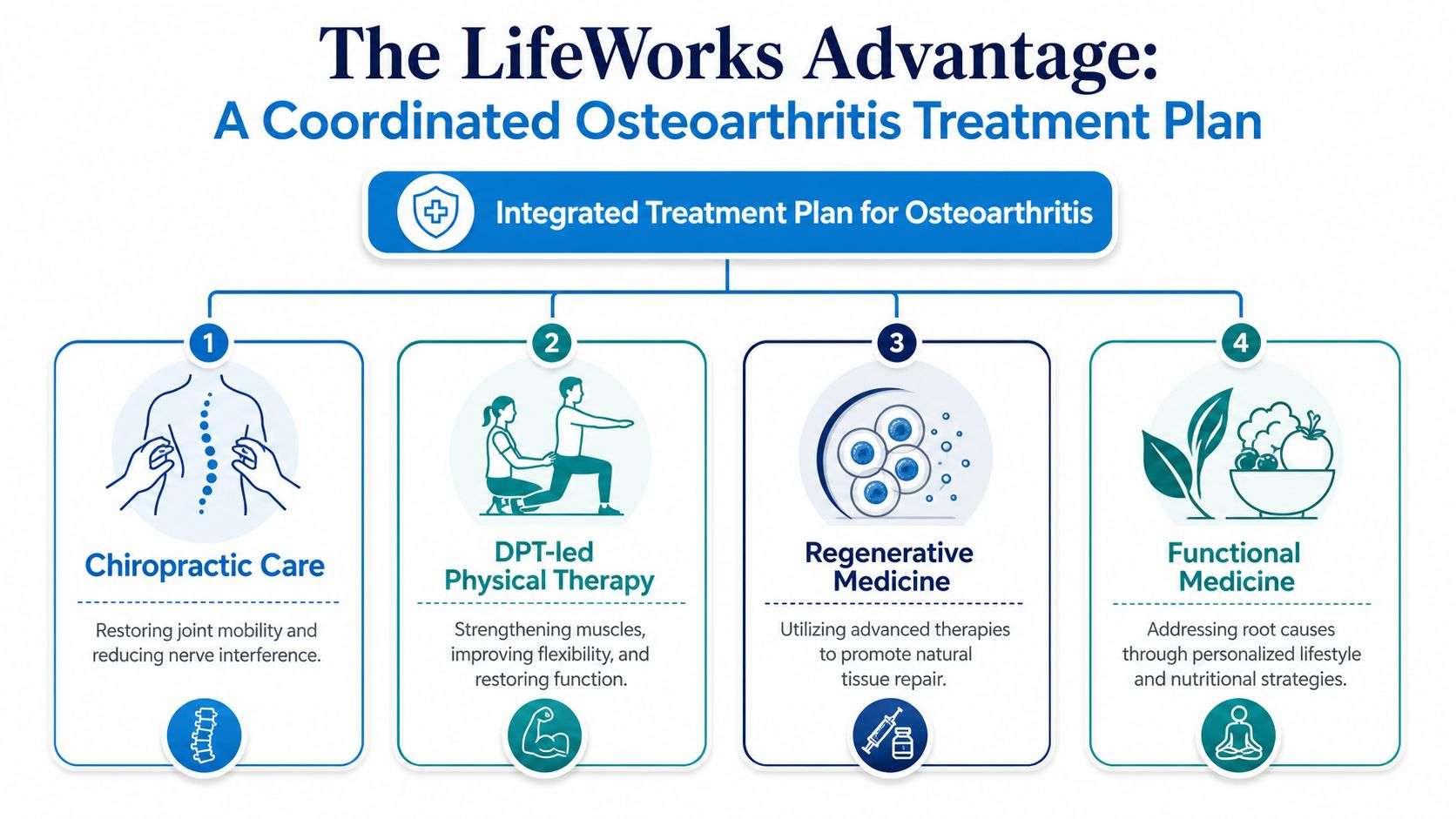
That is why LifeWorks is built around four coordinated pillars under one roof: Chiropractic, Physical Therapy, Regenerative Medicine, and Functional Medicine. Instead of forcing you to piece together care from separate offices, we evaluate how those pieces fit together in your case.
For some patients, the biggest breakthrough comes from restoring joint mechanics and rebuilding strength. For others, that isn't enough until we also address systemic inflammation, nutritional factors, or regenerative options for a more irritated joint. The point is not to chase every treatment. The point is to use the right combination in the right order.
What Is Osteoarthritis and Why Is It So Common Here
You wake up, put your feet on the floor, and your knee or hip feels stiff before the day has even started. By afternoon, the joint loosens a little. Then climbing stairs, getting out of the car, or carrying groceries brings the pain back. That pattern is common in osteoarthritis, and many patients in Shawnee live with it for months or years before they understand what is happening.
Osteoarthritis is a joint condition in which cartilage gradually breaks down, the lining of the joint becomes irritated, and the surrounding bone, ligaments, and muscles start to adapt in unhealthy ways. Pain, stiffness, swelling, and loss of motion follow. Patients often describe it as "bone-on-bone," but that phrase misses the bigger picture. The problem usually develops well before a joint reaches that stage.
Cartilage helps joint surfaces glide and absorb force. As that surface becomes less healthy, the joint handles load poorly. Nearby muscles may tighten to guard the area or weaken from underuse. Small changes in motion turn into larger changes in function. That is why osteoarthritis affects daily life so quickly, even when imaging does not look dramatic.
Why so many people in Shawnee deal with it
Around Shawnee and the Kansas City metro, I see osteoarthritis show up in several familiar patterns. Some adults carry the effects of old sports injuries, physically demanding jobs, or years of repetitive lifting. Others spend most of the week sitting, then ask stiff, underprepared joints to handle yardwork, pickleball, golf, or long walks on the weekend.
Weight gain, poor sleep, blood sugar issues, and chronic low-grade inflammation can also make a joint more reactive and slower to recover. Patients who want a better sense of how whole-body inflammation affects pain often benefit from learning how to reduce systemic inflammation.
Age matters, but age alone does not explain the full story.
Two people can be the same age, have similar X-rays, and function very differently. One has better strength, better joint control, and fewer inflammatory triggers. The other has been compensating for years. That difference is why osteoarthritis care works best when it follows patient-centered treatment approaches instead of treating every arthritic joint as the same problem.
Why this diagnosis is often misunderstood
Many patients are told they have arthritis and are left with the impression that nothing can be done except wait, limit activity, and manage pain as it worsens. That message is incomplete. Osteoarthritis is common, but it is not a reason to give up on movement or accept a steady decline in function.
What matters is catching the pattern early. Morning stiffness, pain after activity, reduced confidence on stairs, and a joint that no longer feels stable are all signs that the problem is affecting more than cartilage alone. The earlier those changes are addressed, the more options you usually have to protect the joint and keep doing the activities that matter to you.
In Shawnee, that often means looking beyond the diagnosis itself and asking better clinical questions. Which movements are overloading the joint? What old injury changed the way you walk? What health factors are keeping irritation high? Those answers shape treatment far more than the label of arthritis by itself.
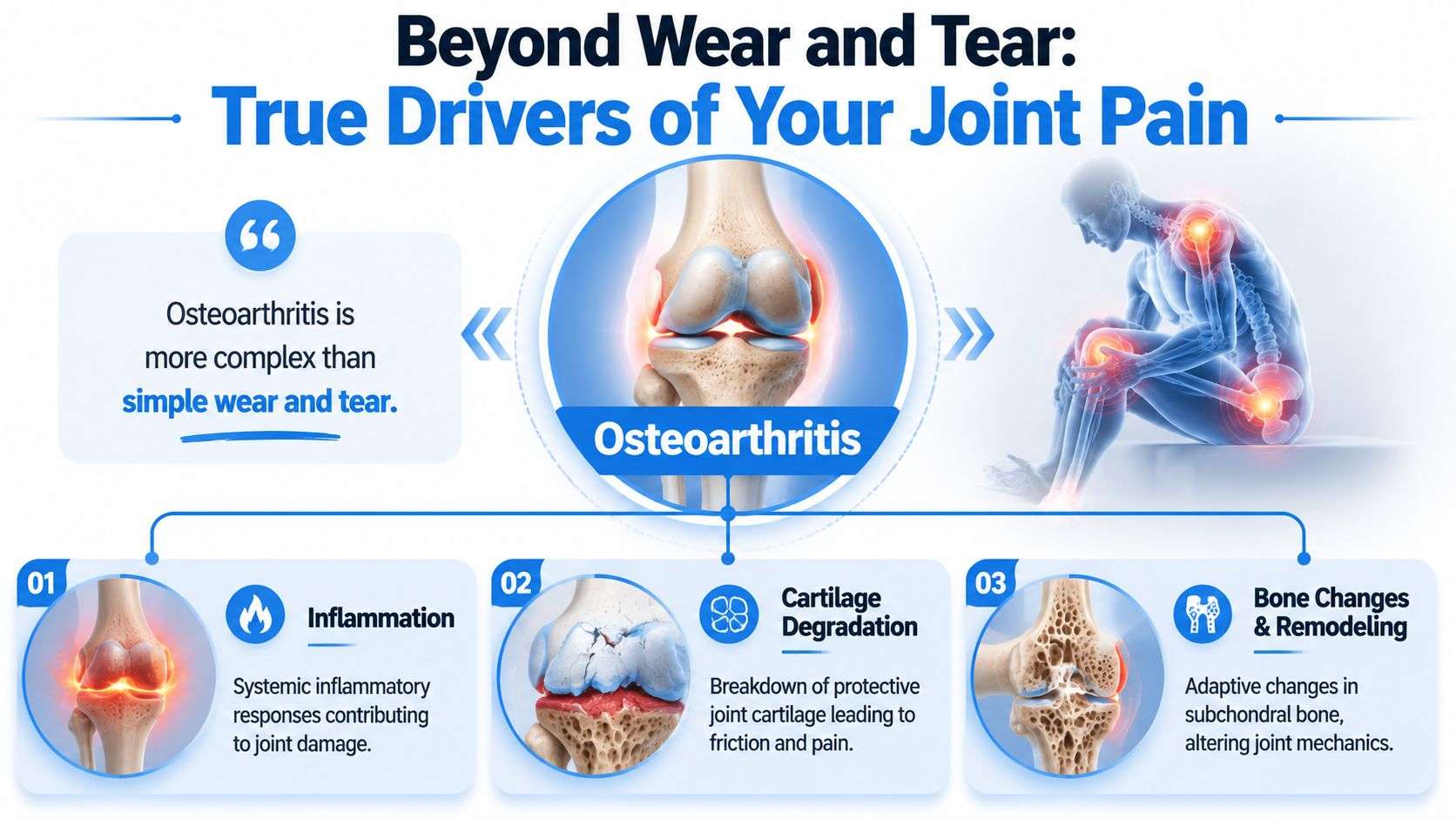
Beyond Wear and Tear The True Drivers of Your Joint Pain
The phrase "wear and tear" sounds simple, but it gives many people the wrong idea. It makes osteoarthritis sound passive, inevitable, and disconnected from the rest of your health. In practice, your joint pain is usually being pushed by several overlapping drivers.
Biomechanics change the way force hits the joint
A joint rarely fails in isolation. Weak hips can overload a knee. Restricted ankle motion can shift stress upward. Poor spinal and pelvic mechanics can change the way you walk, stand, and climb stairs. Over time, those movement faults increase pressure in places the joint doesn't tolerate well.
This is why two people with similar X-rays can feel very different. One person has better muscle support and cleaner movement patterns. The other has compensation layered on top of joint changes.
Inflammation keeps the area irritated
Osteoarthritis is not just structural. It also has an inflammatory component. Local inflammation inside the joint contributes to swelling, pain sensitivity, and stiffness. Systemic inflammation can make the whole process more stubborn.
At LifeWorks, this is one reason we pay attention to nutrition, sleep, metabolic health, recovery capacity, and broader inflammatory load. If you want to understand that piece in more depth, our guide on reducing systemic inflammation is a useful starting point.
A painful joint is often the place you feel the problem, not the only place the problem exists.
Metabolic health affects joint health more than most people realize
Blood sugar regulation, body composition, energy production, gut health, and other metabolic factors can influence how your tissues heal and how inflamed you feel day to day. A root-cause approach thus differs from symptom-only care. Instead of asking only, "Where does it hurt?" we also ask, "What is making this joint less resilient?"
That broader framework aligns with patient-centered treatment approaches that look at structural, biological, and lifestyle factors together rather than acting as if pain exists in a vacuum.
Cartilage and bone changes are part of a bigger process
Once cartilage degrades, the bone beneath it adapts. The joint lining may become irritated. Muscles guarding the area can become chronically tight. Your brain begins to anticipate pain with movement, and that changes the way you move even more.
Here is the practical takeaway:
- Pain isn't the whole map. The sore spot matters, but so does what loads it.
- Imaging isn't the whole story. Joint changes may be real, but they don't tell you how strong, stable, or adaptable you can become.
- The drivers interact. Mechanical stress, inflammation, and metabolic strain often reinforce each other.
That is why effective care has to be coordinated. If you only address one of those layers, the others often keep the cycle going.
Why a Single Treatment Approach Often Falls Short
A common Shawnee scenario goes like this. Your knee feels better for a week or two after one treatment, then the pain returns when you walk the dog, climb stairs, or get up from a chair. That usually does not mean the treatment failed. It means one part of the problem was treated while the other drivers stayed active.
I see this often with osteoarthritis. Patients are told to pick one lane: medication, an injection, exercise, or joint-focused hands-on care. Each option has value. None of them can reliably carry the whole case by itself when pain is being driven by irritated tissue, poor joint mechanics, muscle inhibition, and overload during daily movement.
What symptom-only care tends to miss
Pain relief matters. I want patients to hurt less. But if pain decreases and the joint is still being loaded the same wrong way, the relief usually fades.
That is why oral medication alone rarely changes the full trajectory of osteoarthritis. It can reduce day-to-day discomfort. It does not restore hip strength, improve balance, correct a stiff ankle, or help a patient stop shifting weight away from the painful side.
Injections have a role too. They can calm an acute flare and create a better window for movement and rehab. Used in isolation, though, they often become a reset button instead of a true plan.
The same problem shows up with exercise. A good rehab program can improve strength, confidence, and function, but timing and sequencing matter. If a joint is highly reactive, if swelling keeps returning, or if tissue irritation is limiting progress, some patients need more support to make exercise productive. In selected cases, that may include regenerative medicine options for joint pain as part of a broader plan, not as a shortcut around rehab.
The real trade-off patients face
Single-modality care is simpler. It is also narrower.
| Approach | What it may help | What it often leaves unresolved |
|---|---|---|
| Medication alone | Pain, stiffness during flares | Strength loss, movement faults, joint stability |
| Injection alone | Short-term irritation and swelling | Loading patterns, muscle control, long-term function |
| Rehab alone | Strength, mobility, confidence with movement | Pain control during flares, selected tissue-healing needs |
| Hands-on care alone | Joint motion, mechanics, short-term relief | Strength deficits, conditioning, inflammatory triggers |
| Integrated care | Pain, mechanics, strength, function together | Requires coordination and patient follow-through |
That coordination matters more than many patients realize.
A knee does not function in isolation. If the foot collapses, the hip is weak, the pelvis is not controlling load well, and the joint is already irritated, a single treatment can help for a while without changing the pattern that keeps provoking symptoms.
Why fragmented care often feels disappointing
Fragmented care asks each provider to handle one slice of the problem. The medication visit addresses pain. The injection visit addresses inflammation. The therapy visit addresses strength. The patient is left trying to connect the dots.
That is a hard way to recover.
A coordinated plan works better because the treatments support each other. Pain is managed enough for movement to improve. Mechanics are addressed so exercise reinforces the joint instead of aggravating it. Strength gains then hold the progress in place longer. That is the difference between short-term symptom control and a plan built for lasting function.
Patients in Lenexa and nearby Shawnee communities are often relieved to hear this. They were not doing anything wrong. They were trying to solve a layered problem with one tool at a time.
The LifeWorks Advantage A Coordinated Osteoarthritis Treatment Plan
A patient may come in for knee arthritis, but the treatment plan rarely stays limited to the knee. At LifeWorks Integrative Health, Dr. Matthew Gianforte, DC, builds care around the question that matters in real practice: what is still overloading the joint, and what combination of treatments will effectively change that?
Chiropractic care restores cleaner mechanics
When the spine, pelvis, or extremity joints lose motion, force shifts somewhere else. Chiropractic Care helps restore mobility, reduce compensations, and improve how the rest of the body supports an arthritic joint.
The goal is straightforward. Improve the mechanical environment around the joint so each step, squat, and transition asks less from irritated tissue.
Physical therapy builds stability that lasts outside the clinic
Physical Therapy matters because osteoarthritis changes movement long before X-rays tell the whole story. Patients often shorten their stride, avoid loading one side, brace during stairs, or lose hip and core control without realizing it. A DPT-led rehab plan addresses those patterns with strength work, mobility training, balance, and progression that matches the joint's tolerance.
Consistency matters here. Exercise helps, but the benefit fades when the program stops too early or never advances beyond a few basic drills.
Regenerative medicine can support the plan in selected cases
For some patients, Regenerative Medicine adds another useful layer. The point is not to chase a procedure and hope it solves everything. The point is to match the procedure to the patient, then support it with the right rehab and load management so the joint has a fair chance to calm down and function better.
Our approach to regenerative medicine for joint pain reflects that trade-off. PRP, hyaluronic acid, and other joint-focused procedures may help the right patient, but they work better when strength, gait, and daily mechanics are being addressed at the same time.
Functional medicine addresses the factors that keep flares active
Functional Medicine looks at the background issues that can keep pain louder than the joint findings alone would suggest. Poor sleep, higher inflammatory load, insulin resistance, slow recovery, digestive problems, and nutrient gaps can all affect how often symptoms flare and how well tissue responds to treatment. In selected cases, deeper lab review helps clarify that picture.
A coordinated plan may include:
- Movement correction: Joint mechanics, gait, balance, and protective movement habits
- Rehab progression: Strength, mobility, and therapeutic exercise matched to tolerance
- Joint support procedures: PRP, hyaluronic acid, or other options when clinically appropriate
- Inflammation and metabolic support: Nutrition, sleep, supplements, and targeted lab review
This is the practical advantage of coordinated care. Instead of getting one piece of help from four different directions, you get one plan with four parts that support each other. That usually gives patients a better shot at durable pain relief, steadier function, and fewer setbacks in real life.
A Patient's Journey From Pain to Progress in Shawnee
A common osteoarthritis case in our clinic looks something like this. You live in Shawnee, you're in your 50s or 60s, and your knee has been bothering you long enough that you've stopped trusting it. You still go to work, still run errands, still try to stay active, but your world has narrowed. Walking the dog is shorter now. You avoid kneeling in the yard. You sit out more than you want to when family is over.

The first visit usually changes the conversation
Instead of hearing only, "Your knee has arthritis," you get a fuller explanation. Maybe the knee is irritated, but the hip on that side is weak. Maybe ankle mobility is limited. Maybe your gait has shifted enough that the low back is now involved too. Maybe your history suggests systemic inflammation is amplifying every flare.
That kind of evaluation matters because it changes the goal. You are no longer just chasing pain relief. You are identifying what has been feeding the pain.
The plan feels more connected
A patient like this may start with a mix of joint-supportive chiropractic care, a graded physical therapy program, and home exercises that are simple enough to do consistently. If the joint is a good fit for advanced options, regenerative procedures may be discussed. If recovery is slower than expected, functional medicine work may help uncover why.
In practical terms, progress often looks like this:
- Early stage: Less stiffness in the morning and better tolerance for basic walking
- Middle stage: Improved confidence on stairs, better balance, and less post-activity soreness
- Later stage: More normal daily movement and the ability to return to activities that had been avoided
Most patients don't describe success as "my X-ray changed." They describe success as walking, sleeping, exercising, and living with less fear.
Why the story matters
This kind of progress doesn't come from one magic treatment. It comes from a plan that adapts as your body changes. For patients driving in from Overland Park or other nearby communities, that often feels like the first time their care has finally made sense.
What to Expect Your First Steps Toward Relief
You wake up already planning around your joint. Which stairs to avoid. How long you can stand in the kitchen. Whether this is the day your knee or hip forces you to cut plans short. By the time patients call our Shawnee clinic, many are not just asking for pain relief. They want a clear plan and an honest answer about what is likely to help.
What happens first
The first step is a conversation, then an evaluation with a purpose. We review where the pain is, how long it has been building, what activities are limited, what treatments you have already tried, and whether the problem is staying local or starting to affect the way you walk, bend, sleep, or exercise.
At your first visit, we also look at movement quality, joint mechanics, strength deficits, and any imaging you already have. The goal is to identify the drivers of your symptoms so treatment is based on your actual pattern, not a generic arthritis template.
If rehab is likely to be part of your care, our guide to physical therapy for arthritis explains how that process is used to improve support around the joint and carry over into daily life.
How your care plan gets built
After the exam, recommendations are coordinated across providers. That matters because osteoarthritis rarely behaves like a one-lane problem. One patient may need joint-supportive chiropractic care to reduce mechanical stress. Another may need a DPT-led strengthening plan to improve load tolerance. Some patients are appropriate for regenerative treatment discussions, while others need closer attention to inflammatory factors, recovery habits, or metabolic health.
I find that patients relax once the plan makes sense. They can see why one treatment alone did not get them very far, and why combining the right pieces often leads to steadier progress.
If PRP or another procedure is discussed, it should be presented as one part of care, not as a shortcut around rehab, movement correction, or follow-through at home.
Practical concerns patients usually ask about
Cost and logistics matter. Some services may be covered by insurance, while others may be self-pay depending on the treatment recommended. LifeWorks also works with eligible OWCP Federal Workers' Compensation cases and can help with the documentation and billing side.
The early process is straightforward:
- Reach out: Call 913-441-2293 or request a consultation online.
- Come prepared: Bring prior imaging, a medication list, and a quick summary of what makes the joint better or worse.
- Get a clear recommendation: You should leave understanding what is being advised, what the first phase is meant to accomplish, and what progress should look like.
- Begin care with a plan you can follow: The right program has to fit real life, or it usually does not last.
For many patients in Shawnee, the first visit is the point where scattered advice turns into an organized treatment strategy. That alone can lower a lot of anxiety.
Frequently Asked Questions About Osteoarthritis Care
Can a chiropractor in Shawnee KS help with osteoarthritis
Yes, in the right context. Chiropractic care can help improve joint mechanics, reduce compensation, and make movement less stressful for the irritated area. It is not a claim to cure osteoarthritis or regrow cartilage. It is one part of a broader strategy that often works better when paired with rehab and, when appropriate, regenerative or functional medicine care.
Is physical therapy in Shawnee Kansas better than just resting my joint
Generally, yes. Rest may calm a flare temporarily, but prolonged underuse often leads to more weakness, more stiffness, and less confidence in the joint. Well-designed physical therapy helps you load the area safely, improve support around the joint, and build function you can keep in daily life.
Does regenerative medicine in Shawnee KS actually work for knee arthritis
It can help selected patients, but it should be used carefully and as part of a complete plan. PRP and similar options may support the joint environment, yet they don't replace movement correction, strength work, and inflammation management. If you're looking up PRP therapy Kansas City, the key question is not just whether the procedure is offered. It is whether the clinic also addresses the rehab piece that helps the result translate into real function.
What's the best treatment for osteoarthritis in Shawnee
The best treatment is usually not one treatment. It is a plan that matches the drivers of your pain. For some people that means chiropractor vs physical therapist near me is the wrong question because they need both. Others also need joint injections, metabolic support, or a deeper look at inflammatory triggers before progress really holds.
How long does osteoarthritis treatment take
That depends on how advanced the joint changes are, how long you've been compensating, and whether the plan addresses the full picture. Some people notice early changes in pain and mobility relatively quickly. Long-term improvement usually requires consistency, especially when rebuilding strength, movement quality, and tolerance for activity.
Can injections replace physical therapy or chiropractic care
Usually no. Injections may reduce irritation or improve the joint environment, but they don't teach the body how to move better. They don't automatically rebuild strength. They don't fix the gait change, the weak hip, or the balance issue that may have helped create the problem in the first place.
Is functional medicine relevant if my main problem is joint pain
Often, yes. Joint pain may be the symptom you feel most clearly, but broader inflammatory and metabolic issues can influence how often you flare and how well you recover. That is especially true if you also deal with fatigue, digestive issues, weight concerns, or blood sugar problems. Patients searching for chronic fatigue functional medicine KC are often asking the same root-cause question from a different starting point.
What can I do at home for osteoarthritis between visits
Home care matters a lot. The exact plan should fit your exam findings, but these are common foundations:
- Keep moving consistently: Short, tolerable movement sessions usually beat all-or-nothing effort.
- Use therapeutic exercise as prescribed: Do the boring basics. They often matter most.
- Support inflammation wisely: Some patients benefit from an omega-3 inflammation-support formula or a joint-support category supplement from Dr. Matt's supplement line at drmattgianforte.com, based on mechanism rather than hype.
- Address metabolic stress: If weight, energy crashes, or cravings are part of the picture, nutrition work matters.
- Protect sleep: Poor sleep amplifies pain sensitivity.
- Stay honest about aggravating patterns: Repeated kneeling, uneven loading, and sudden bursts of activity often keep joints irritated.
If related symptoms are part of your bigger picture, these pages may also help: knee pain, back pain, neuropathy, and weight loss and metabolic health.
If you're in Shawnee and you're tired of piecing together fragmented answers, LifeWorks Integrative Health offers a more coordinated path forward at 19701 W 65th Ter, Shawnee, KS 66218. Call 913-441-2293 or schedule a free consultation. If you're coming from Shawnee or elsewhere in Johnson County, our team will help you look at the whole picture, not just the joint that hurts.


